
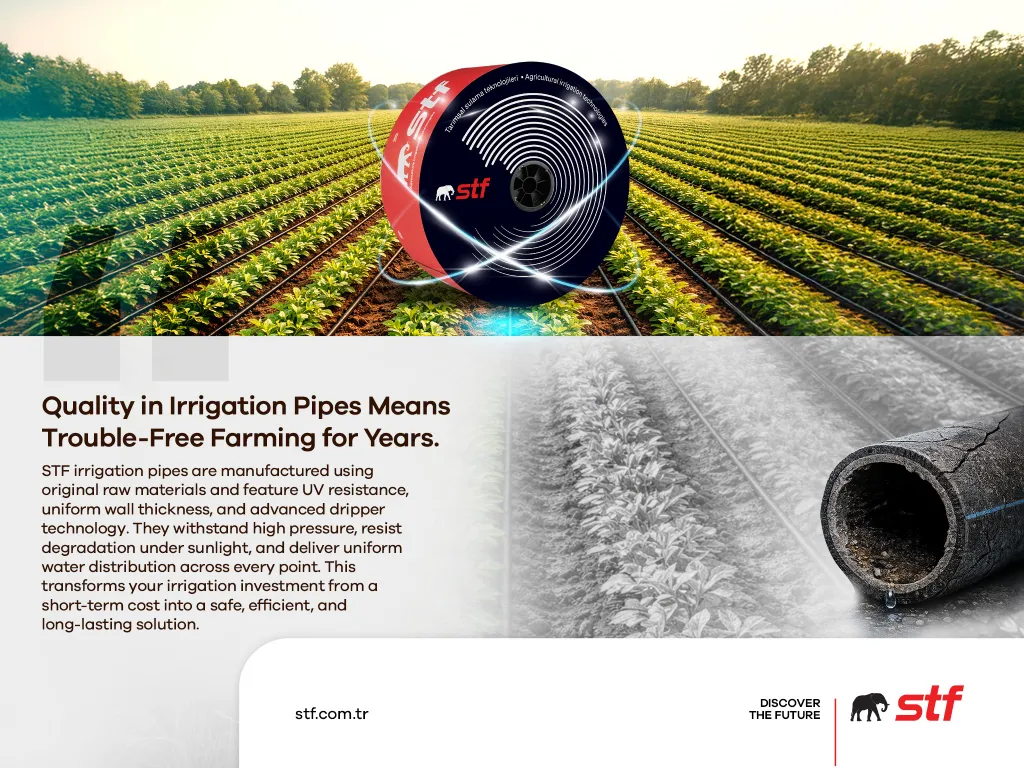
How to Choose the Best Drip Irrigation Pipe? | STF Quality Guide
When investing in agricultural irrigation, choosing a pipe is not just a matter of purchasing a material; it is planning for the next 5-10 years of your field. At STF Agricultural Technologies, in our factory in Konya, we often encounter a situation while manufacturing to world standards: two pipes that look the same from the outside perform completely differently in the field.So, how do you recognize a quality drip irrigation pipe? Here are 4 critical criteria that will protect your investment:1. Raw Material Quality: Original HDPE vs. Recycled
The secret to a quality pipe lies in the purity of the polyethylene used. Pipes made from recycled plastic are cheaper but quickly become brittle and crack under the sun.- STF Difference:We maximize product life by using high-density polyethylene (HDPE) and original raw materials in our pipes.
- Durability: The original raw material also exhibits high resistance to chemical fertilizers and acids.
2. UV Additive: Full Protection Against Sunlight
In regions with strong sunlight, pipes are constantly exposed to ultraviolet (UV) rays. Pipes lacking UV additives lose their structural integrity and shape within a single season.- Special Formula: The special UV ray stabilizers we add to our pipes during the production process prevent the pipe from cracking under the sun.
- Long Life: Thanks to this protection, pipes can be used safely in multi-year projects (vineyards, gardens, etc.).
3. Wall Thickness and Homogeneous Pressure Resistance
The pipe’s “wall thickness” determines its resistance to working pressure. In low-quality pipes, the wall thickness is not uniform at every point; this causes the pipe to burst at its weakest point when pressure rises in the system.- Precision Measurement:We produce pipes with equal thickness per millimeter, ranging from 5 mil (0.125 mm) to 60 mil (1.5 mm), leaving no room for surprises in your field.
- Safety: Equal wall thickness minimizes the risk of bursting in high-pressure systems.
4. Emitter (Labyrinth) Technology
The heart of the drip irrigation pipe is its emitters. A quality emitter should not be affected by sediment in the water and should deliver the same amount of water to the plant at the beginning of the line as to the plant at the end.- Clog Resistance:Our specially developed labyrinth technology drippers actively prevent clogging by providing high-turbulence flow.
- Homogeneous Distribution:Focused on delivering equal water and nutrients to every plant, even in long drip lines.
